
Describe the operation.
Miji builds and runs it.
Miji is an enterprise decision automation platform. It turns business policy into governed workflows. Describe the operation and its AI drafts the workflow for you to review — your policy as versioned rules and decision tables, exact calculations, AI steps where judgment helps, human approval where it matters, and a tamper-evident record of every decision.
30-minute call · no prep needed · or watch the 1-minute film
Live today in lending, with manufactured-home lenders first. A product of Canopy Mind, Inc.
You describe it
When a retailer submits a home-only application, pull credit, work out DTI and LTV, apply our chattel LTV grid and eligibility policy, and send anything referred to underwriting before we answer the retailer.
Miji drafts the workflow
- 1TriggerApplication received from a retailer
- 2ConnectorEquifax credit pull
- 3CalculationDTI and LTV, exact decimal
- 4Lookup tableChattel LTV grid — product × home condition × occupancy
- 5RuleChattel eligibility, v4
- 6Human approvalUnderwriting, if referred — any one of three
- 7ConnectorDecision back to the retailer
Illustration. You review the draft before anything runs; every run lands on the audit trail.
From a described process to a decision you can explain.
The real product, with sample data: AI drafts the workflow, rules decide, people approve what needs judgement, and every change is tested before it ships.
Tell us your operation. We’ll show you how Miji would run it.
Describe what arrives, what decides it and who signs off, or pick one below. Miji’s planner drafts it the way it would inside the product, and the draft can go straight into a free workspace.
- The steps, in the engine’s own step types
- Where a person steps in
- What you’d connect
- The record it leaves
Nothing you type is published. Your description is kept for 30 days so the draft can open in your workspace, then deleted. Please don’t paste real customer data.
When does Miji make sense?
If these sound like your work, it is the kind of operation Miji is built for. Check yours in three short steps and see how Miji would run it.
Each item needs a decision
Applications, claims, requests or exceptions arrive, and each one has to be approved, declined, priced or routed.
The decision follows a written policy
Rules, thresholds or eligibility criteria decide it, not one person's judgement alone.
It involves calculations or lookup tables
Ratios, scores, prices or limits are worked out, or read from a grid or rate table.
Some cases need a person
Most items could be decided automatically, but some must be reviewed or signed off.
It spans several systems
Data comes from or goes to other systems, APIs, databases or outside services.
You have to explain it later
To an auditor, a regulator, a partner or the customer: what decided, and who approved.
The policy changes over time
Thresholds, rules or criteria are updated more often than the software around them.
Lending runs on Miji now.
Manufactured-home lenders first.
Prequalification runs end to end on the platform below — the application, credit, the maths, your overlays as versioned rules, and a person on anything that needs judgment. We are taking it to manufactured-home lenders first: chattel and land-home, applications that arrive through retailers, and limits that depend on the home as much as the borrower.
See Miji for LendersA file walked from the retailer to a decision, what is built and what is not, and screens from the running product. Mortgage and other consumer lenders run on the same engine.
An answer while the buyer is still at the retailer
Prequalification runs as a workflow rather than a queue — intake, credit, the maths and your overlays execute when the application arrives, not when somebody picks the file up.
A rate sheet change is a table edit, not a release
LTV and pricing grids are effective-dated lookup tables — by product, home condition, occupancy — and the most specific row wins. Change a row; no deployment, no engineer.
Your team works the referrals, not every file
Threshold routing sends only the files that cross a line to underwriting, and the reviewer sees what the policy flagged rather than the whole file.
From a description of the work to a record of every decision.
One engine, and everything below runs in it today.
Describe it
Tell Miji what the operation should do. Its AI drafts a runnable workflow — steps, branches, approvals and connections — for you to review, not a blank canvas to fill.
Put policy in rules
Eligibility, thresholds and routing live in versioned rules and decision tables your team edits. Every version is fingerprinted, and you see which workflows use a rule before you change it.
Use AI where judgment helps
An AI step sits inside a deterministic workflow, with the model and key you choose, and its output lands on the same record as everything else.
Keep the maths exact
Calculations run with exact decimal arithmetic and built-in finance functions, not a model doing sums. Rate sheets and grids are effective-dated lookup tables where the most specific row wins.
Put a person where it matters
Approval gates route by threshold to a group and resolve by any-one, all or majority. Work queues show your team the cases waiting on them.
Keep a record that holds up
Every action, decision and approval is recorded against the run on a hash-chained audit trail, with the rule version that decided — by fingerprint — alongside it.
Reaches the systems you already run. Around 30 connector templates with scoped, managed credentials, your own HTTP endpoints, and an MCP server.
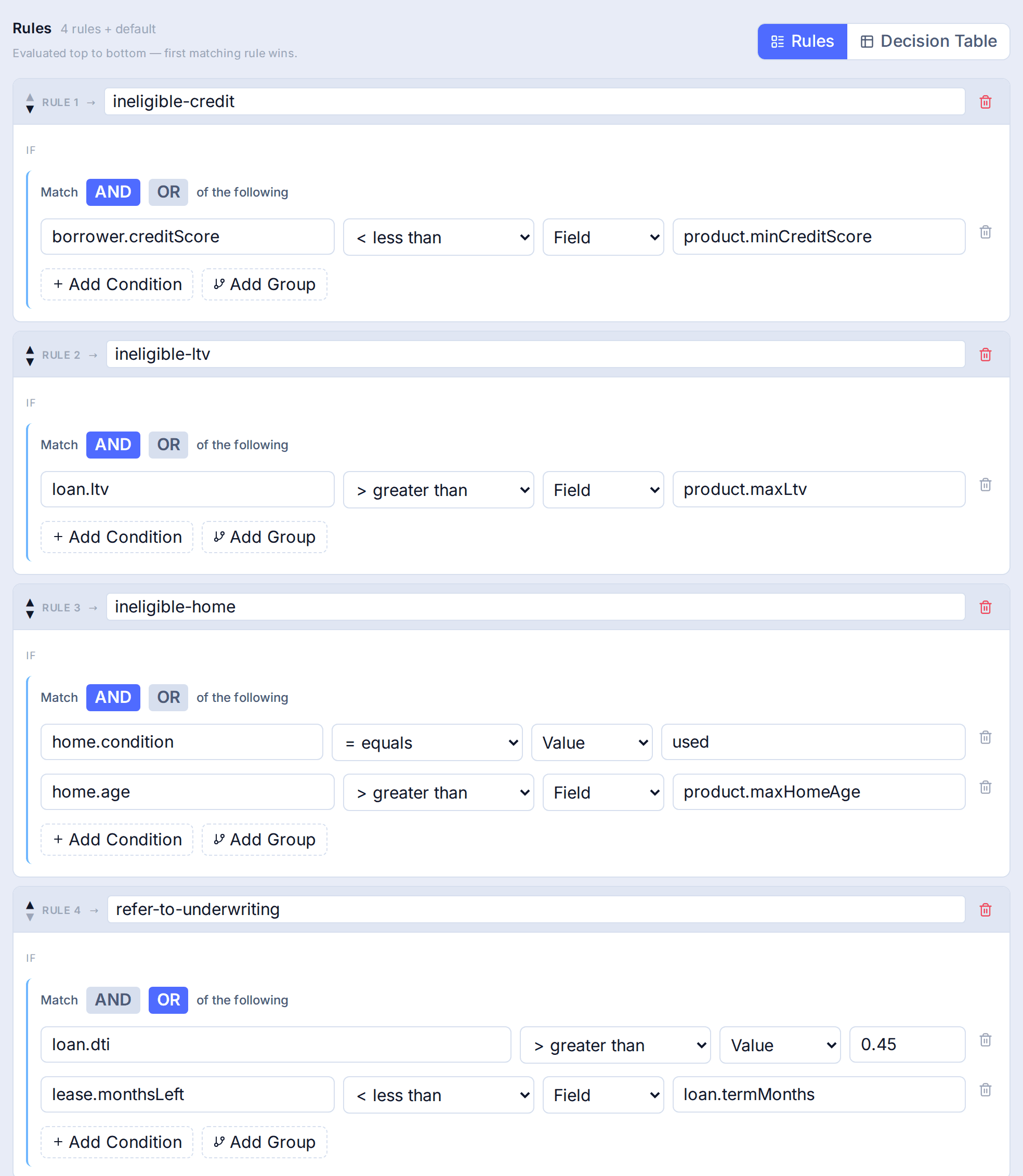
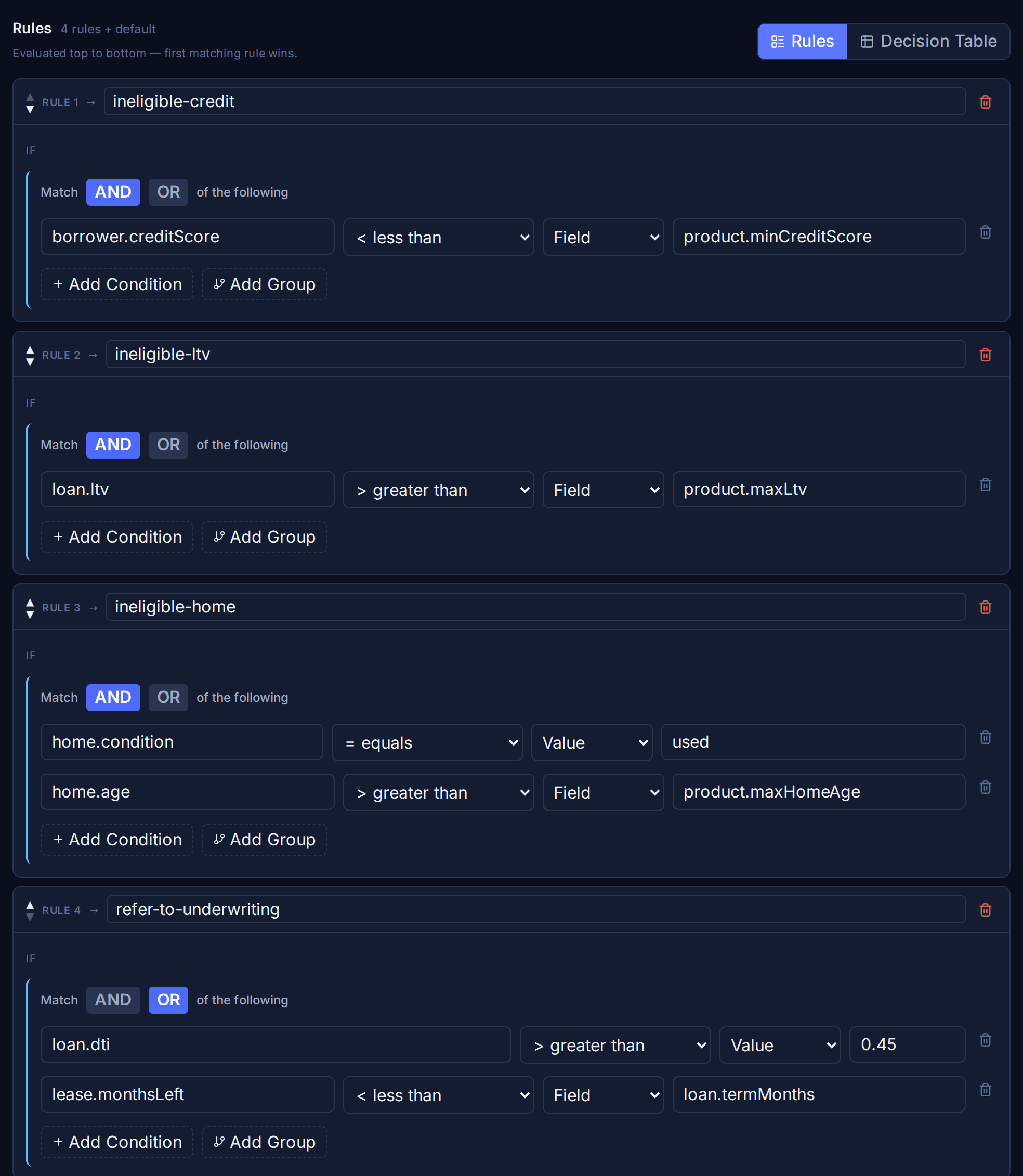
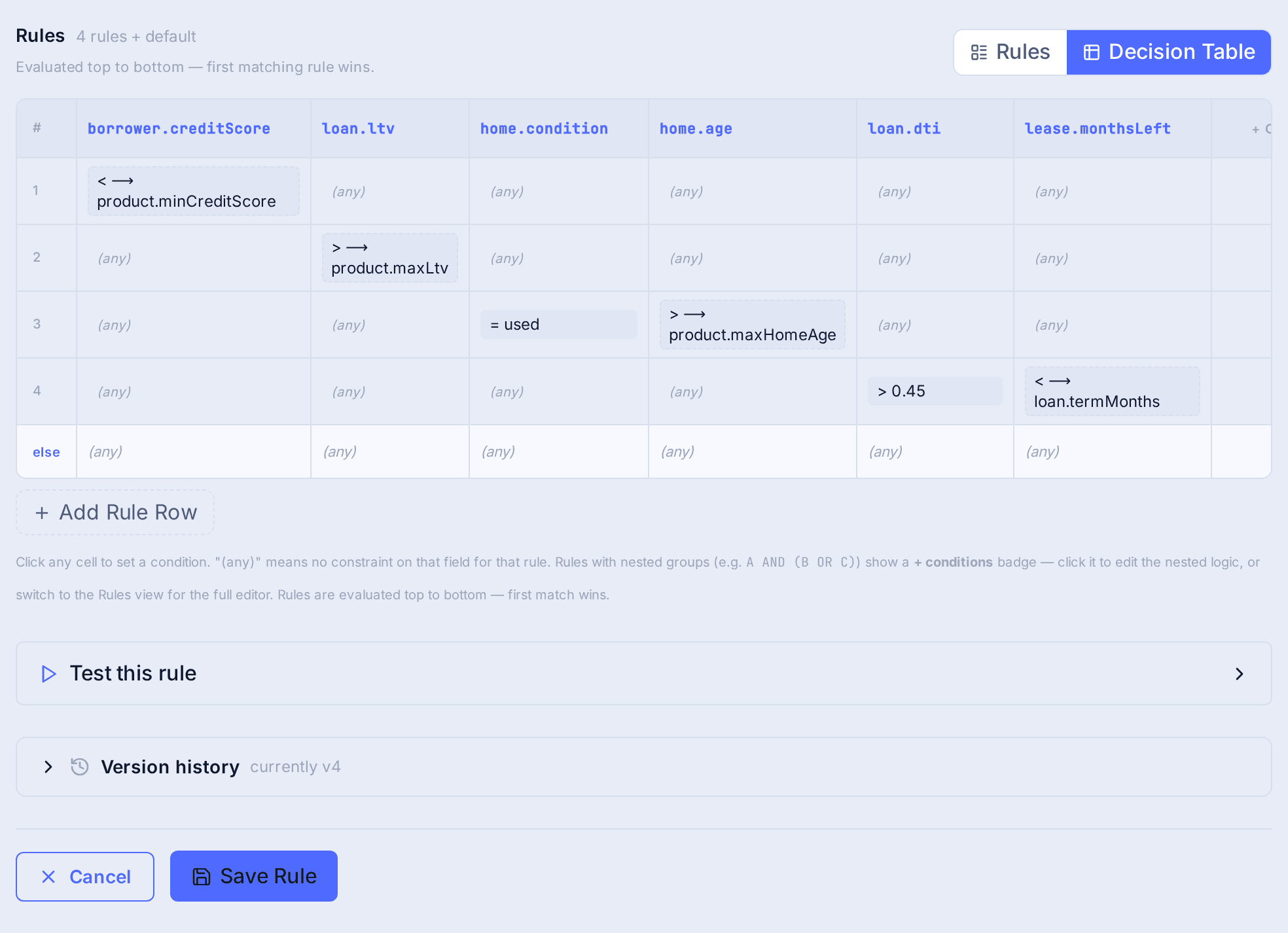
This is the screen, not a rendering of it.
Both images are captured from the running application, against a manufactured-home credit policy.
Policy as conditions, not code
Each branch is an outcome. Each condition compares a fact about the case against a value, another field, or an expression evaluated at run time — so a limit can live in a table your team edits rather than in logic someone has to deploy. Here, three limits point at the product, and the lot lease is checked against the loan term.
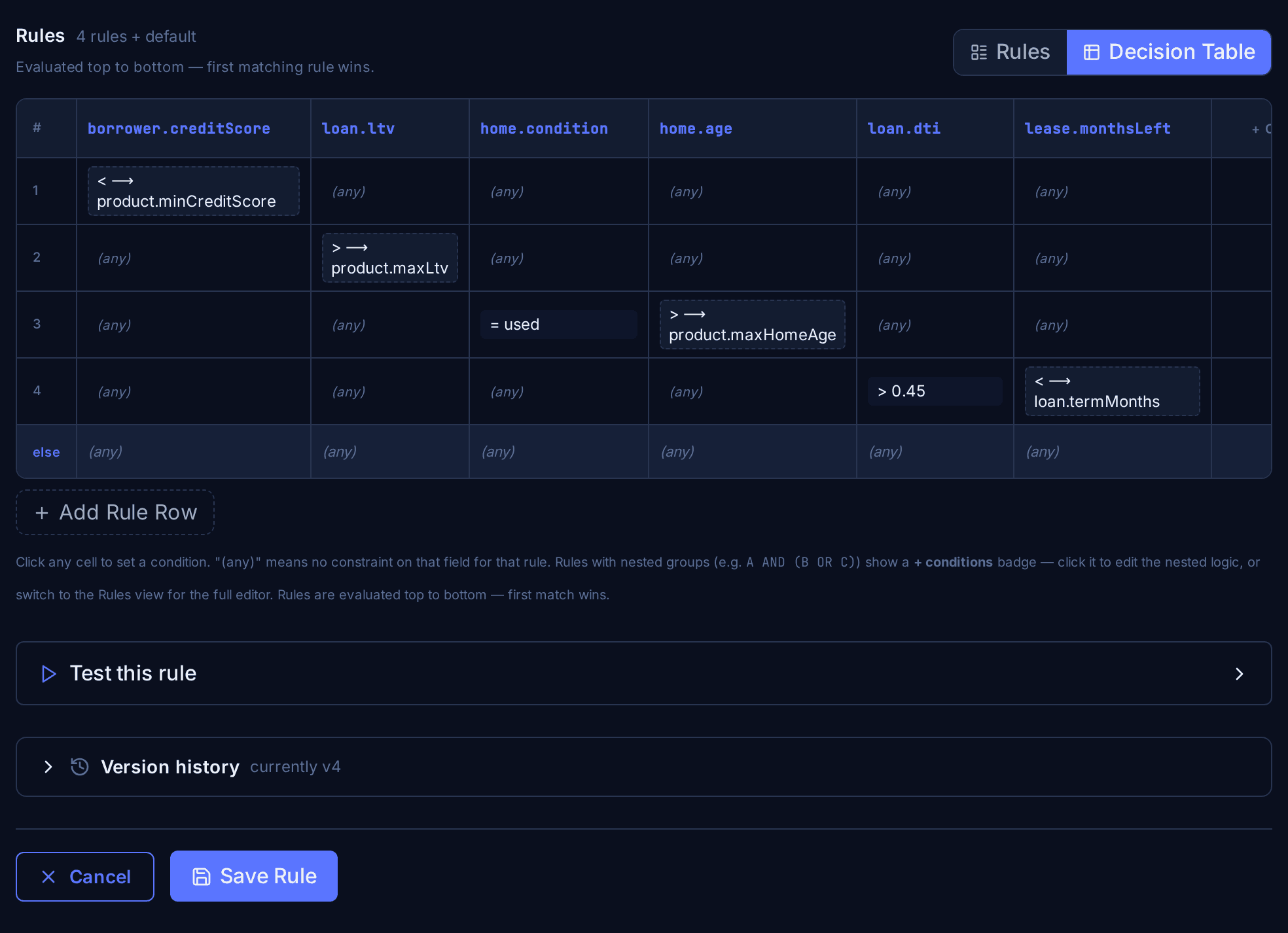
The same policy, as a decision table
One rule, two views. Columns are the facts the policy reads, rows are the outcomes, and (any) means a row places no constraint on that field. Rows evaluate top to bottom and the first match wins.
See the editor on a policy like yours — thirty minutes, no prep.
Book a demoBuilt for decisions, not just task automation.
Task automation moves work from one step to the next. Miji decides the work, under a policy you can change safely and explain afterwards.
- What it does
- Task automation: When something happens, do the next step.
- Miji: Decides each case — approve, decline, price, route — the way your policy says.
- Where the logic lives
- Task automation: In the settings of each step, one integration at a time.
- Miji: In versioned rules and decision tables your team edits, with every version fingerprinted.
- Numbers
- Task automation: Whatever the step or the model returns.
- Miji: Exact decimal arithmetic and effective-dated lookup tables, not a model doing sums.
- People
- Task automation: A notification, if someone sets one up.
- Miji: Approval gates routed by threshold, resolved by any-one, all or majority.
- Changing the policy
- Task automation: Edit it live and watch what happens.
- Miji: Replay recorded runs, shadow live traffic or A/B test it before it decides anything.
- Afterwards
- Task automation: A run history of what was called.
- Miji: A tamper-evident record of what decided, under which rule version, and who approved.
If your work has this shape, it runs on Miji.
Lending is where Miji runs today. The engine underneath is not about lending — it runs any operation where work arrives, is checked against a policy, needs a decision, sometimes needs a person, and has to be explained later.
- Work arrives
- Checked against policy
- Decided
- A person where needed
- Acted on
- Recorded
Insurance claims triage
Check cover, summarise the notes, fast-track the clear claims and route the rest to an adjuster.
Connector · AI step · Rule · Approval
Prior authorisation
Match a request against coverage criteria and send the cases that need clinical review to a reviewer.
Lookup table · Rule · Approval
Vendor and customer onboarding
Collect the documents, check them against your policy, and get sign-off from every team that must give it.
File · Rule · All-must-approve
Compliance review
Route regulatory changes through review, flag what affects you, and escalate to counsel before the deadline.
AI step · Rule · Approval
Application triage
Classify grant requests, proposals or tickets, check they are complete, and route each to the right queue.
AI step · Rule · Work queue
Invoice exceptions
Match invoices against purchase orders and send only the mismatches to someone who can approve them.
Connector · Calculation · Approval
These are examples of what the engine builds, not packages that ship pre-built. Lending is the only pre-built package set today; insurance is next, shaped by the partners who arrive first.
Start free. Grow into governed operations.
Every plan runs the same engine: versioned rules, AI steps, human approval and a full Work Trail.
Free
Try Miji on real work
$0
Free forever
Start free- 3 active workflows
- 500 workflow runs a month
- 2 seats
- 2 installed templates
- Bring your own AI key
- 3 months of run history
Starter
For a team putting its first operations into production
Pricing soon
30-day free trial
Start 30-day trial- 15 active workflows
- 5,000 workflow runs a month
- 10 seats
- 10 installed templates
- Bring your own AI key
- Approval forms
- 12 months of run history
Professional
Case management, the lab and verticals
Pricing soon
30-day free trial
Start 30-day trial- 100 active workflows
- 50,000 workflow runs a month
- 50 seats
- 50 installed templates
- Bring your own AI key
- Approval forms
- Case management: lifecycles, cases and gates
- The Lab: A/B tests, what-if and shadow runs
- Tenant databases
- The lending vertical: loans and conditions
- 25 months of run history
Enterprise
Your own sign-on, contract limits and long retention
Custom
Priced for your contract
Contact sales- Limits set to fit your contract
- Bring your own AI key
- Approval forms
- Case management: lifecycles, cases and gates
- The Lab: A/B tests, what-if and shadow runs
- Tenant databases
- Your own single sign-on
- The lending vertical: loans and conditions
- Run history kept as long as you need
All paid plans start with a 30-day free trial. No card needed.
- Is there a free plan?
- Yes. Free never ends and has no trial to run out. It is for trying Miji on real work.
- What happens when a trial ends?
- The workspace moves to Free unless you subscribe. Nothing you built is deleted.
- Can I use my own AI key?
- Yes, on every plan. Plans with a Miji AI allowance can also use the platform's models.
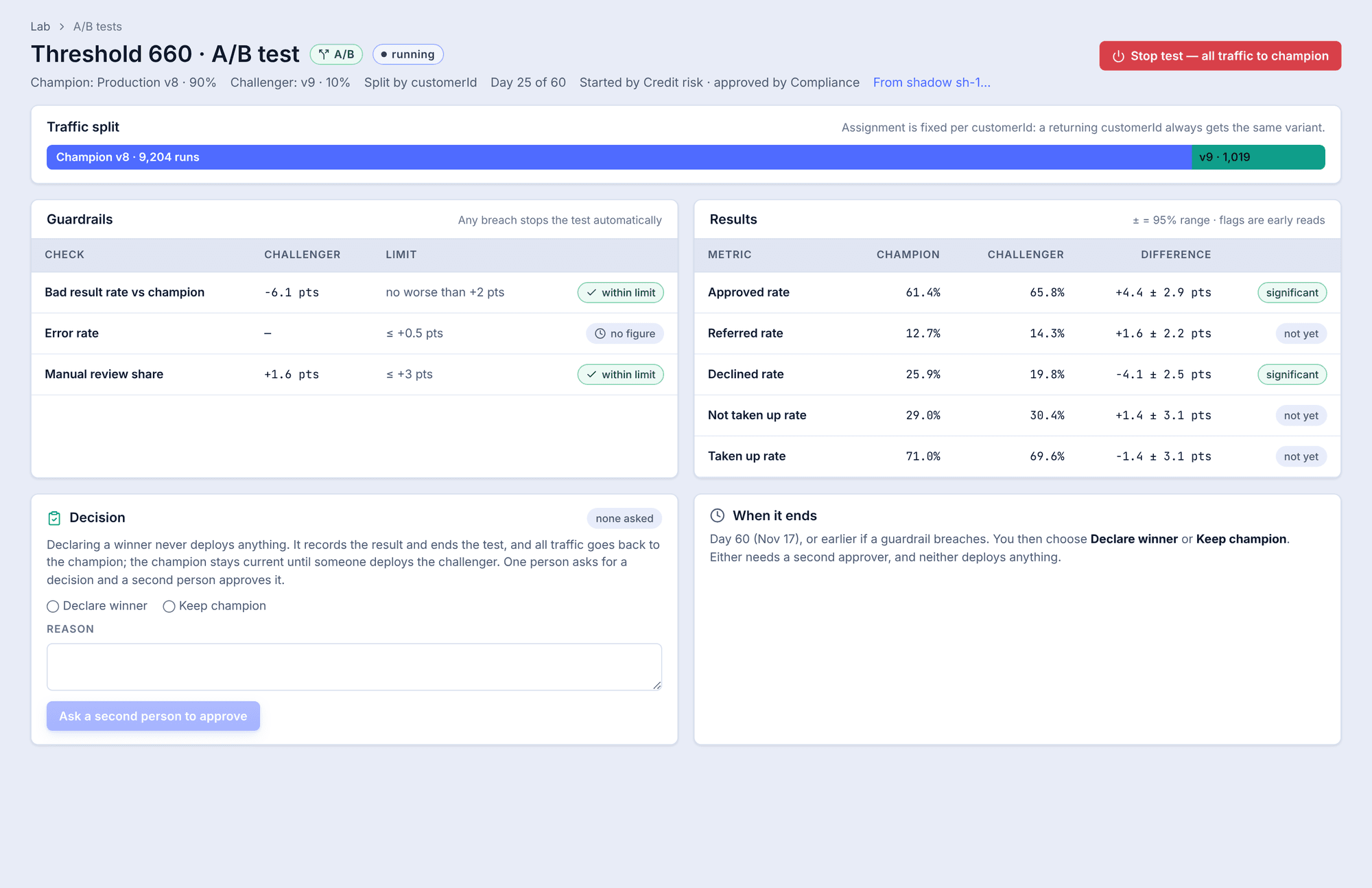
Test a policy change on real traffic before it decides anything.
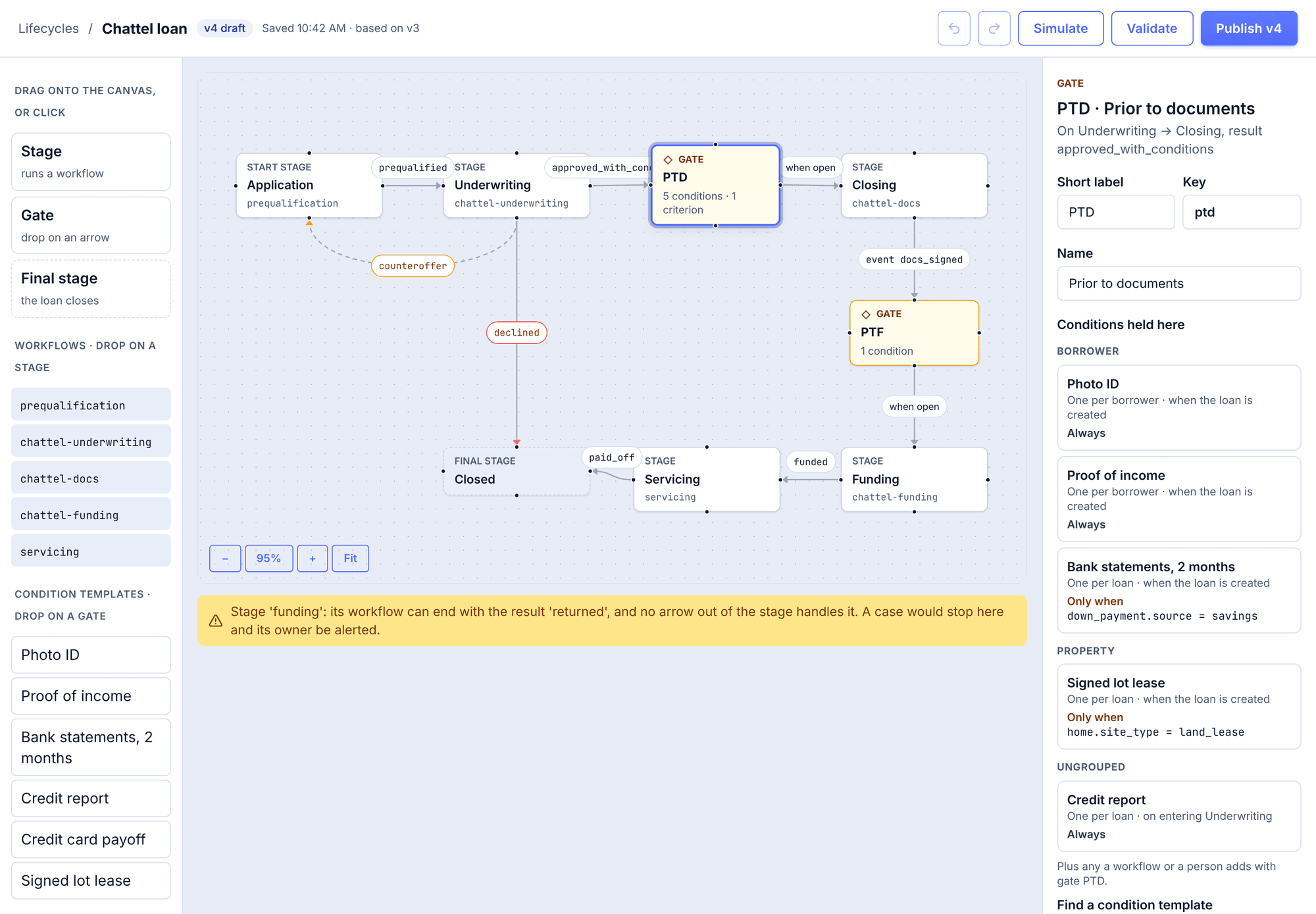
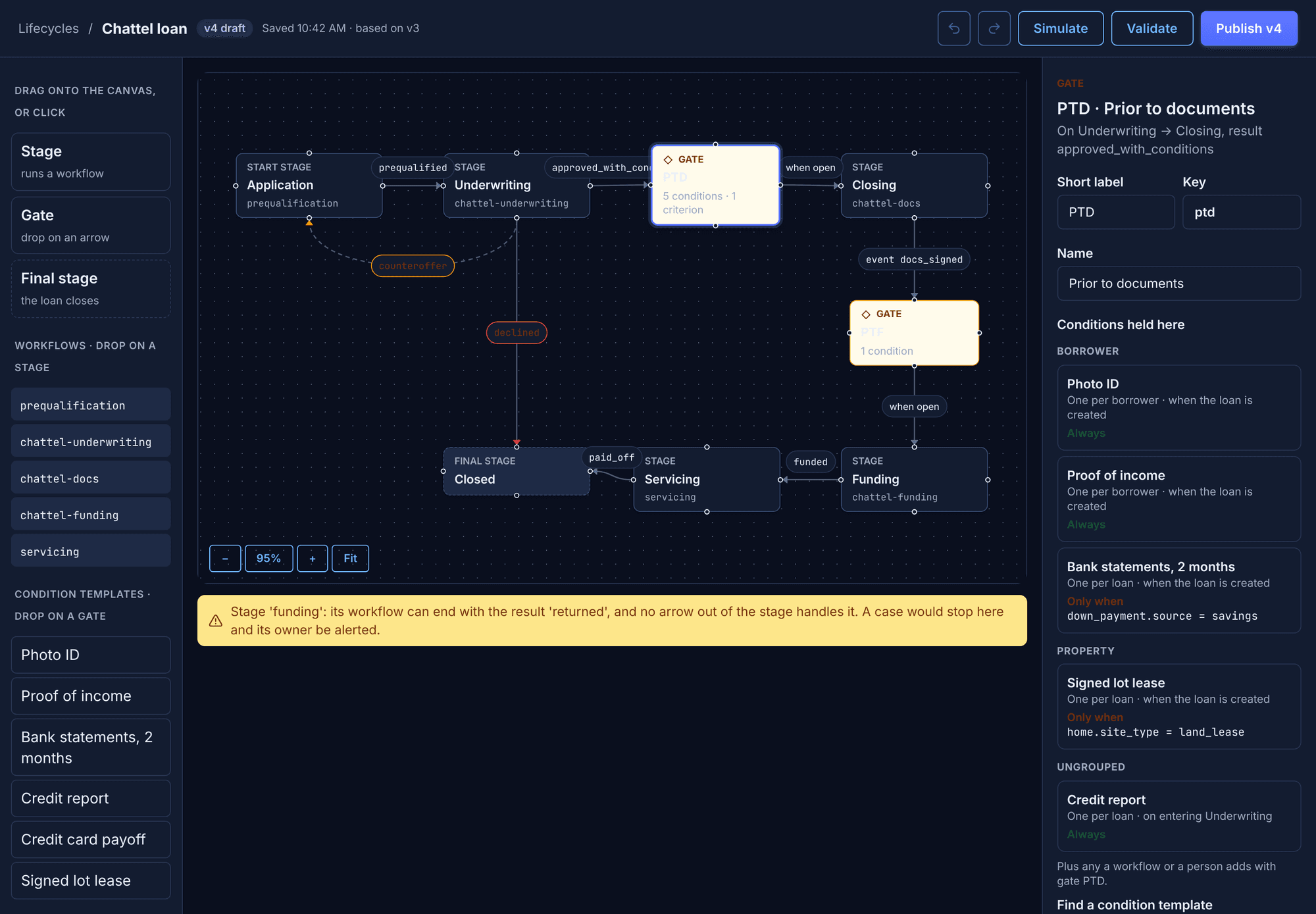
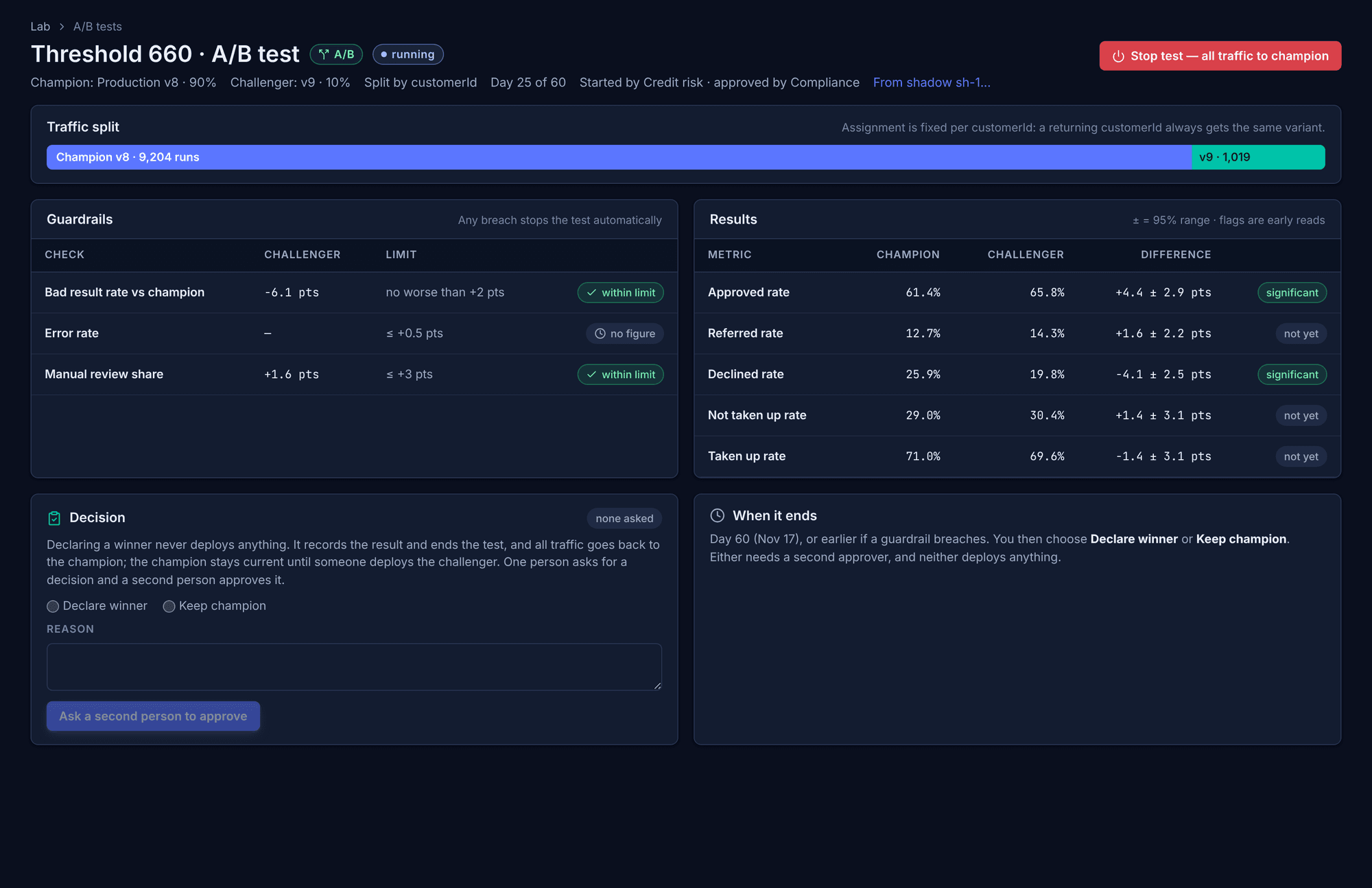
The Lab replays one recorded run or thousands, shadows a challenger beside live traffic, keeps scenario sets, and A/B tests a share of real traffic with guardrails. And lifecycles now hold a case at a gate until its conditions are met.
- Replay
- Batch replay
- Shadow runs
- Scenario sets
- A/B testing
- Gates
- Condition templates
- Working the conditions
Logged is not the same as provable.
Most systems keep logs, and logs can be edited. Miji's audit trail is hash-chained, and it lives in your cloud if you want it to.
Tamper-evident by construction
Every event carries the fingerprint of the one before it, so an edit anywhere breaks the chain — and you can verify the chain on demand from the audit view.
The policy that decided, exactly
A decision records the rule version that answered, by content fingerprint, with the inputs it saw and the branch that fired.
Who approved, and when
Human approvals are recorded against the run they decided, next to everything the workflow did before and after.
Audit trail
Gross monthly income — human verified
Chattel eligibility v4 → refer-to-underwritingloan.dti > 0.45
Underwriting approved — any one of three
each hash includes the previous event's hash · an edit breaks the chain
Model-agnostic
Bring your own models and keys, configured per tenant — no lock-in to one AI vendor, and no exposure when model procurement becomes a contractual question.
Your cloud
Managed, or inside your perimeter. Storage, secrets, sign-in and email each sit behind a provider interface, so the same build runs on GCP, AWS or Azure.
Self-hosted appliance
A scripted, repeatable deployment on PostgreSQL, checked in CI on every pull request. SQL Server support is in conformance testing.
Access and isolation
Role-based access, OIDC single sign-on (Okta, Entra ID, Keycloak), separate test and production environments, and tenant isolation enforced in the database.
White paper
Enterprise Decision Automation White Paper
Which decisions to automate, where AI belongs and where it does not, and how to change a policy without losing the record.
What runs, what is being built, what is next.
Nothing moves up a column because it is nearly done.
Shipped
15Running today, demonstrable on a call.
The workflow engine and AI authoring, versioned rules and decision tables, exact calculations, human approval, the Lab for testing policy changes, case lifecycles with gates and conditions, a hash-chained audit trail, and lending prequalification.
Building
4Started and scoped, with design partners.
A draft, approve and publish lifecycle for policy changes, decision notices, a compliance pack for examiners, and SQL Server for the self-hosted appliance.
Next
5Decided, not started.
Pre-built manufactured-home and servicing packages, fair-lending exports, insurance packages, and goal-first operation.
Not sure your operation fits?
Tell us about one workflow. We'll say whether it fits, and what it would look like on Miji.
Bring an operation. We'll show you it on Miji.
Tell us what the work is — what arrives, what decides it, who has to sign off — and we'll show you how it would run: the workflow, the rules, the approvals and the record it leaves.
Or email hello@mijios.ai