

Prequalify faster. Prove every decision.
For manufactured-home lenders.
Miji runs prequalification end to end — the retailer's application, documents, credit, the maths, your chattel and land-home overlays as versioned rules, and a person on anything that needs judgment — with a tamper-evident record of every step.
30-minute call · bring a rate sheet if you like · no prep needed
Mortgage or other consumer lending? Same engine, your policy — see how. A product of Canopy Mind, Inc.
Queue
Chattel prequalification
Applications
128
last 30 days
Referred
19
to underwriting
Waiting
6
on a person
Median to decision
3.2m
clear files
every run audited · referrals routed to your underwriters
Tell us how a file moves through your shop. We’ll show you how Miji would run it.
Describe what the retailer or borrower sends, what your overlays say and who signs off, or pick one below. The draft uses the same step types that run manufactured-home prequalification today, and it can open in a free workspace with the Lending vertical installed.
- Credit, the maths, your grids and overlays as steps
- Where underwriting steps in
- What you’d connect
- The record an examiner gets
Nothing you type is published. Your description is kept for 30 days so the draft can open in your workspace, then deleted. Please don’t paste a real borrower’s details.
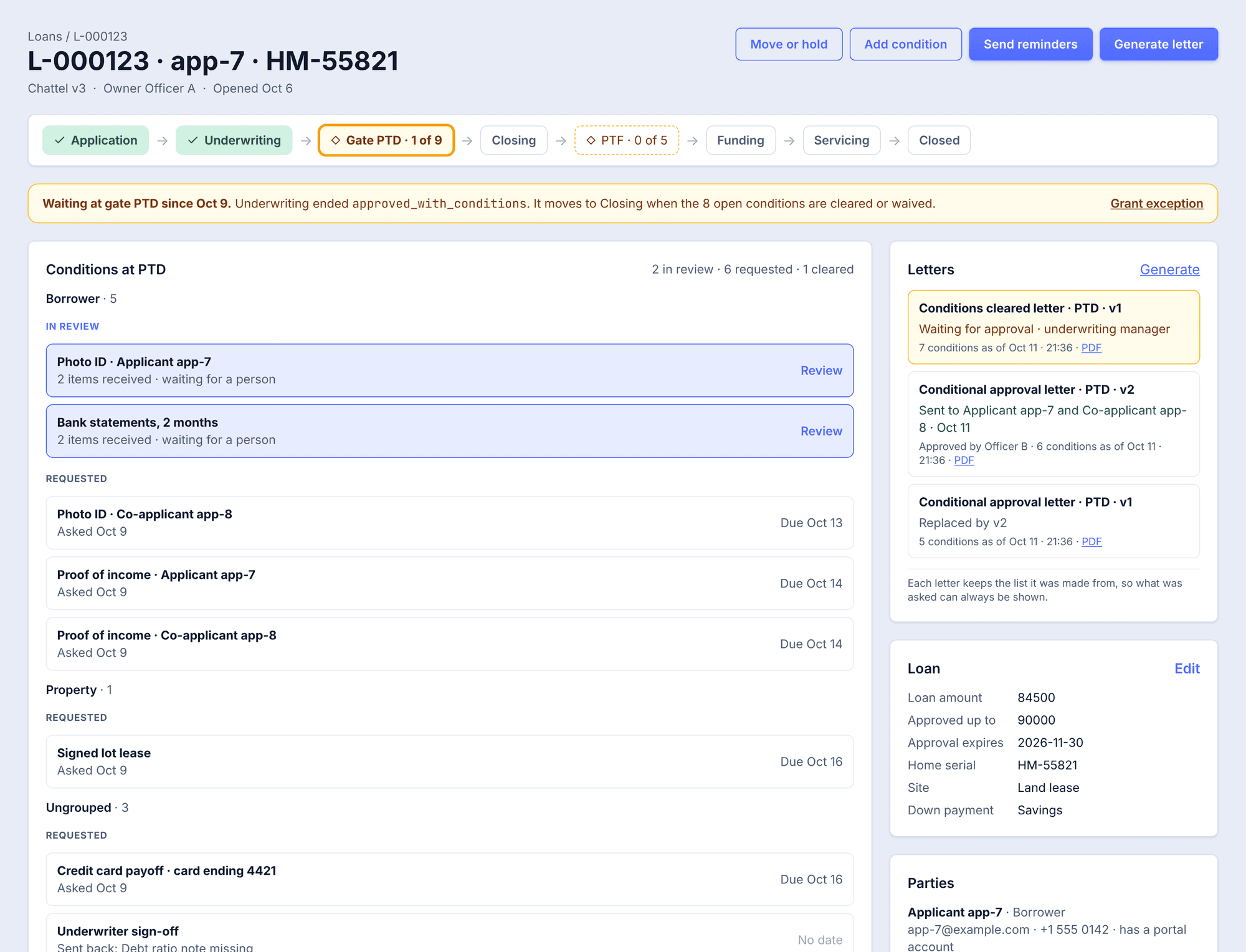
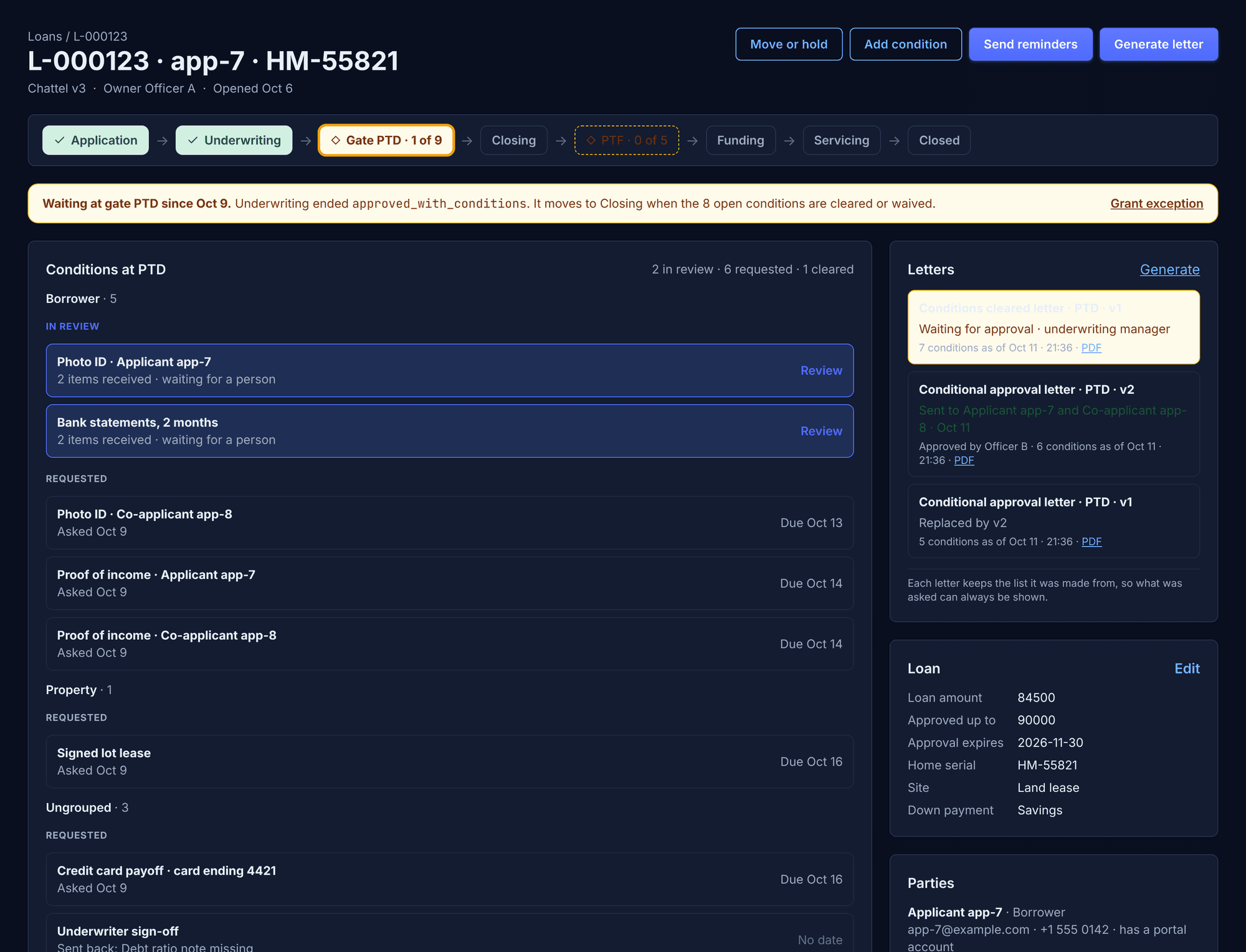
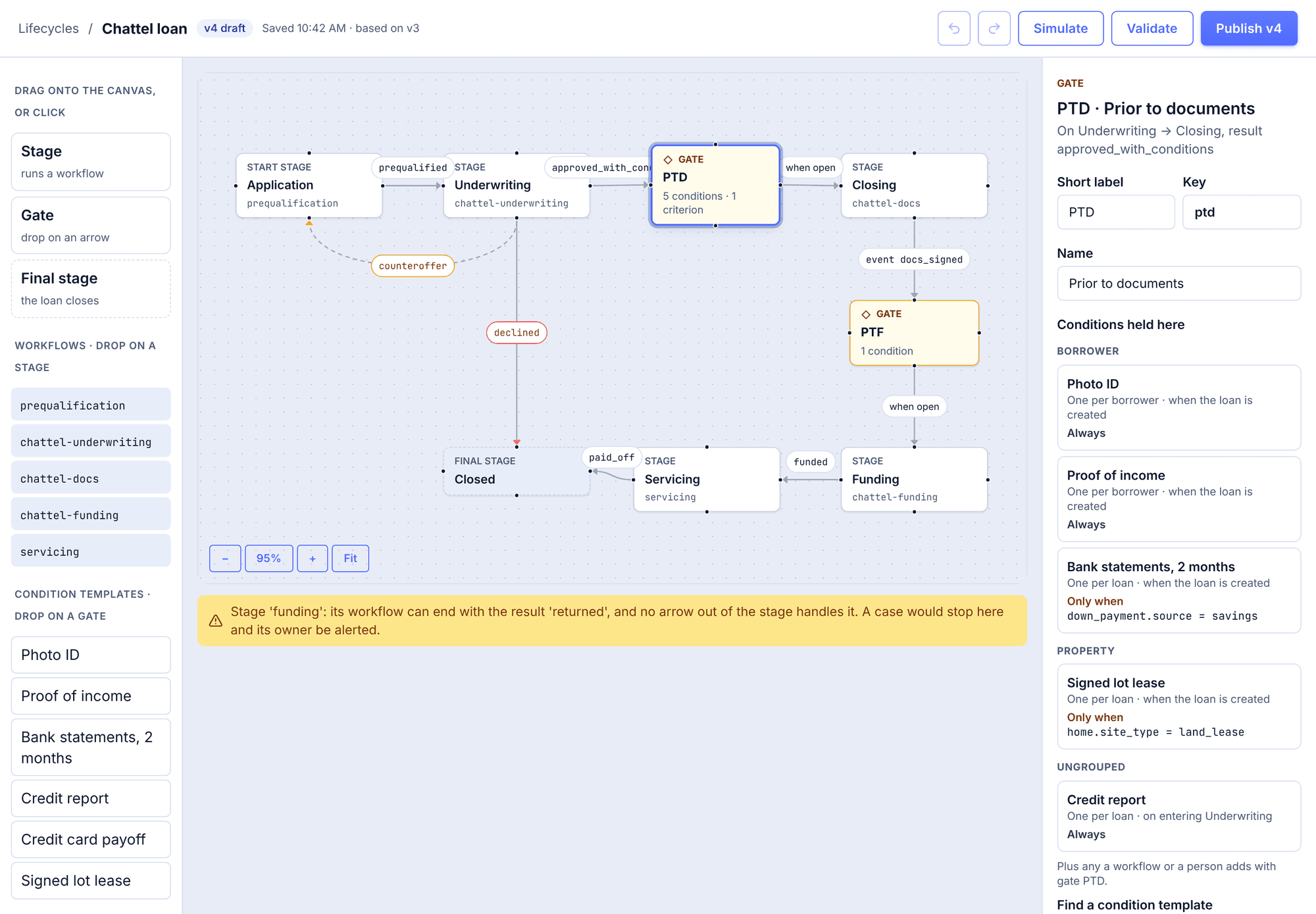
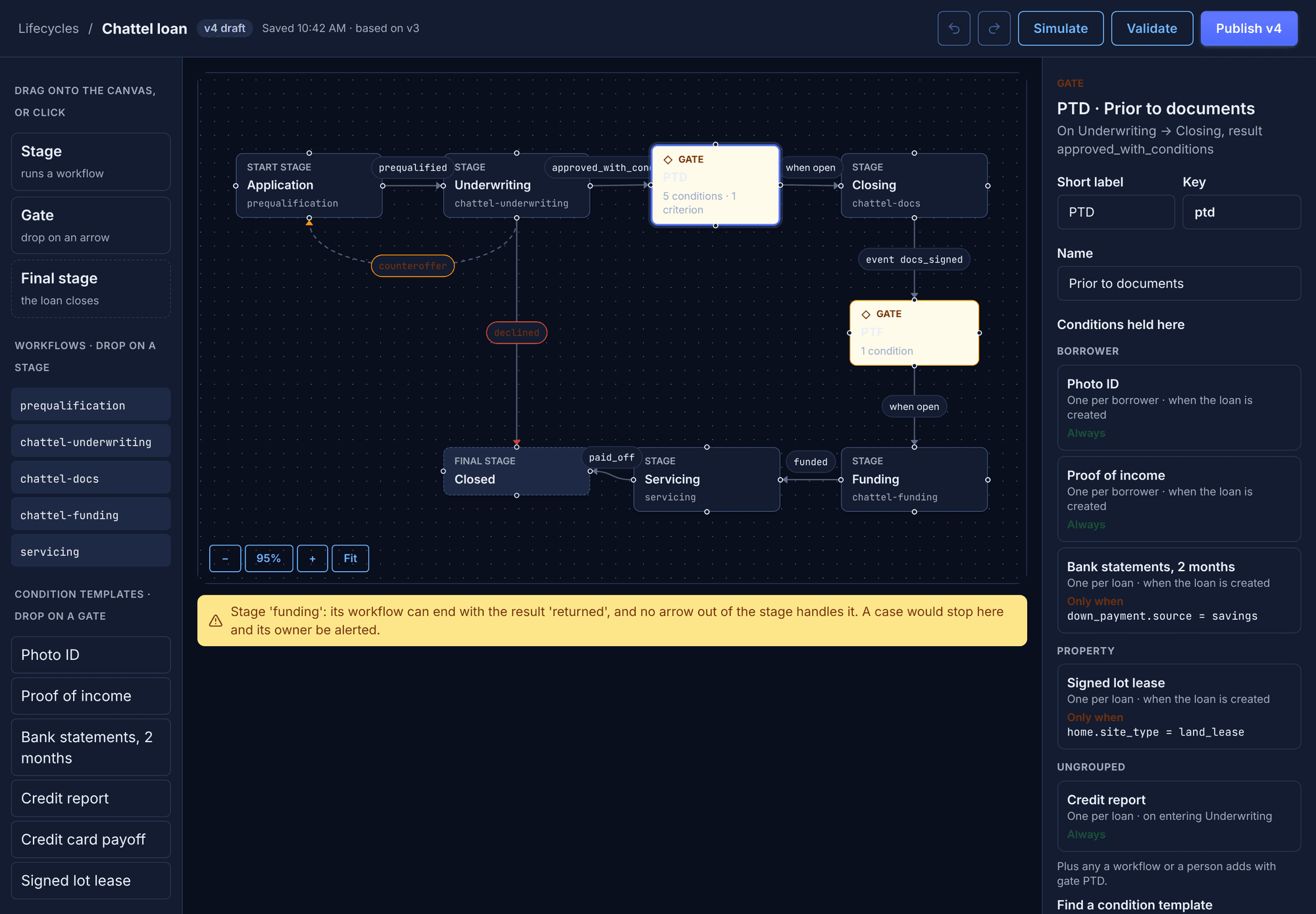
Conditions at PTD and PTF, held on the loan until they clear.
Gates on the loan's lifecycle hold it until each condition is cleared or waived: condition templates, borrower uploads from a phone, checks, letters and reminders. And before a policy change decides a file, replay it, shadow it beside live applications, or A/B test it with guardrails.
- Gates
- Condition templates
- Borrower portal
- Letters
- Replay
- Shadow runs
- A/B testing
An MH file is not a mortgage file with a different address.
Four things that make manufactured-home lending different — and what Miji does with each of them.
The retailer is waiting for an answer
Applications arrive through retail sales centers, often with the buyer still there. Prequalification runs as a workflow the moment the application lands — credit, the maths and your overlays — so a clear file gets an answer without sitting in a queue.
The home matters as much as the borrower
New or used, the home's age, single or multi-section, owned land or a leased lot — your limits depend on it. They live in effective-dated lookup tables keyed by product, home condition and occupancy, and the most specific row wins.
Chattel and land-home are different products
Home-only and land-home loans carry different overlays. Each is its own versioned policy on the same engine, a condition can compare one field against another — a lot lease's remaining months against the loan term — and the version that decided a file is recorded with it.
More files need a person
Thin credit files and exceptions are common, and underwriters are the constraint. Threshold routing sends only the files that cross a line, and your team works them from a queue with what the policy flagged in front of them.
What ships, and what we set up with you. The engine — workflows, rules, lookup grids, approval routing, the audit trail — ships today. Your MH overlays, rate and LTV grids and document list are configured with you during onboarding, from your own product guide. A pre-built manufactured-home package is next on the roadmap, shaped by the lenders who start with us.
Where the money actually is.
Six things the software removes from the operation, each with the mechanism that produces it — so the claim and the component behind it stay attached.
The leverage
It costs $11,898 to originate a loan that earns $727.
That ratio is why operational cost is the whole argument in a stable-rate market. Personnel is roughly two thirds of the cost to originate, and every file your team touches unnecessarily is drawn against a margin this thin.
Take 5% out of the cost to originate and you keep $595 a loan — about 82% of the entire net profit on one.
The per-loan gap between the best and worst cost quintiles is $2,529 — 3.5× the profit on a loan. The difference between operators is larger than the margin itself.
Read that as arithmetic, not as a promise. Those are published industry figures and sums you can check, not measurements of Miji. We are at design-partner stage and have no customer outcome data to quote yet — when we do, it will appear here with the lender's name on it. What we will do on a call is walk your own cost structure through the six mechanisms below and let you put your numbers against them.
A note for manufactured-home lenders. These are forward-mortgage figures. Chattel loans are smaller and priced differently, so the ratio will not be the same — but the shape of the argument is: when the cost to originate is large against the profit on a loan, the files your team does not have to touch are where the margin is. We will run it on your numbers.
Speed to lead
An answer while the buyer is still at the retailer.
Prequalification runs as a workflow, not a queue — intake, credit pull, the maths and your overlays execute on arrival instead of waiting for someone to pick the file up.
Removes The gap between an application and an answer, and the deals lost in it.
Fewer touches per file
Your team reviews what needs judgment, not everything.
Review queues surface blocking findings, conflicts and low-confidence fields. Threshold routing sends only what crosses a line to underwriting, committee or exception approval.
Removes The pass over every file that finds nothing wrong.
Policy changes without a release
An overlay or rate-sheet change is a table edit, the same afternoon.
A condition compares a case fact against a product fact, so a limit lives in a lookup table rather than in logic — including effective-dated grids by product, home condition and occupancy. Rules are versioned and fingerprinted; publishing is an action, not a deployment.
Removes The engineering ticket between a credit decision and its effect.
Arithmetic that does not get argued
The same inputs give the same answer, every time.
DTI, LTV, payment and maximum loan run on the workflow engine with exact decimal arithmetic and built-in finance functions, and the inputs are kept with the run, so a number can be re-derived months later.
Removes Rework, and the reconciliation call that follows a disputed number.
Exam preparation that is already done
'Which policy governed this loan, and why did it decide that?' has an exact answer.
Every action, decision and approval is recorded against the run on a hash-chained audit trail you can verify on demand, and the rule version that answered is recorded by content fingerprint.
Removes The reconstruction exercise before an audit.
Consistency you can evidence
Identical files get identical treatment.
Policy is enforced by the engine rather than interpreted per processor, so variance between people stops being a source of outcome differences you would have to explain.
Removes Processor-to-processor drift, which is a fair-lending exposure before it is an inefficiency.
Cost figures: Mortgage Bankers Association quarterly performance reports (Q1 2026) and MBA Chart of the Week, April 2026.
One manufactured-home file, from the retailer to a decision.
What happens, what mechanism does it, and what your team actually sees.
The retailer submits the application
From your retailer portal or POS, a public form, or an API call. It lands as a record against a versioned application schema that carries your fields — the home's condition, year and sections, and whether the land is owned or leased — and the shape it was captured in is the shape it keeps, even after you change the schema next quarter.
Your team sees Nothing yet. The file appears in the queue.
Documents are collected against the case
Paystubs, bank statements, IDs and the home's paperwork are uploaded and held against the case. The type is read from the file's content rather than trusted from its name, storage is per environment, and every access is on the audit trail. Reading values back out of those documents is not something Miji does today — the facts in the next step come from the application.
Your team sees A case with its documents attached, and an access record for each one.
Facts are verified against your policy
Values captured on the application enter a fact model your verification policy governs: minimum confidence, how many independent sources must agree, which source types are allowed or required, and what tolerance applies to a number, a percentage or a date. Fields you mark critical or sensitive always require a person, and the policy itself is versioned and immutable once published.
Your team sees Verified facts marked as such, with their sources, method and history. A changed value supersedes rather than overwrites, and disagreements are raised as conflicts rather than silently resolved.
Credit is pulled inside the operation
An Equifax OneView pull runs as a step in the workflow, not as a side trip — core credit file, employment and income, alternative data. The access is logged like every other action, and sandbox mode returns static test data while you are still configuring.
Your team sees Credit facts on the same record, under the same audit chain.
The maths runs, and your grid answers
DTI, LTV, maximum loan amount and payment are calculated with exact decimal arithmetic and built-in finance functions — the same inputs give the same answer every time. Your LTV and pricing grid, by product, home condition and occupancy, is an effective-dated lookup table: the most specific row wins, and a new sheet takes effect on its date.
Your team sees Numbers that reconcile, the grid row that answered, and inputs kept with the run so both can be re-derived later.
Policy decides the outcome
Your chattel or land-home overlays run as versioned rules — as a condition tree or a decision table, whichever your team reads faster. A condition can compare one field against another — the home's age against the product's limit, or the months left on a lot lease against the loan term — so a limit lives in a table you edit rather than in logic somebody deploys.
Your team sees A branch: eligible, ineligible with the reason that fired, or refer to underwriting.
A person decides what a person should decide
Threshold routing sends the file to underwriting, credit committee or exception approval. The gate resolves by any-one, all or majority, and the reviewer sees the blocking findings and the low-confidence fields — not the whole file.
Your team sees An exception queue with the cases that need judgment, and only those.
The record stands up afterwards
Every action, decision and approval is recorded against the run on a hash-chained audit trail you can verify on demand. The rule version that answered is recorded by content fingerprint, alongside the inputs it saw.
Your team sees An answer to 'which policy governed this loan, and why did it decide that' — which is the question an examiner actually asks.
Want to see this on a file like yours? Thirty minutes, with your product guide if you like.
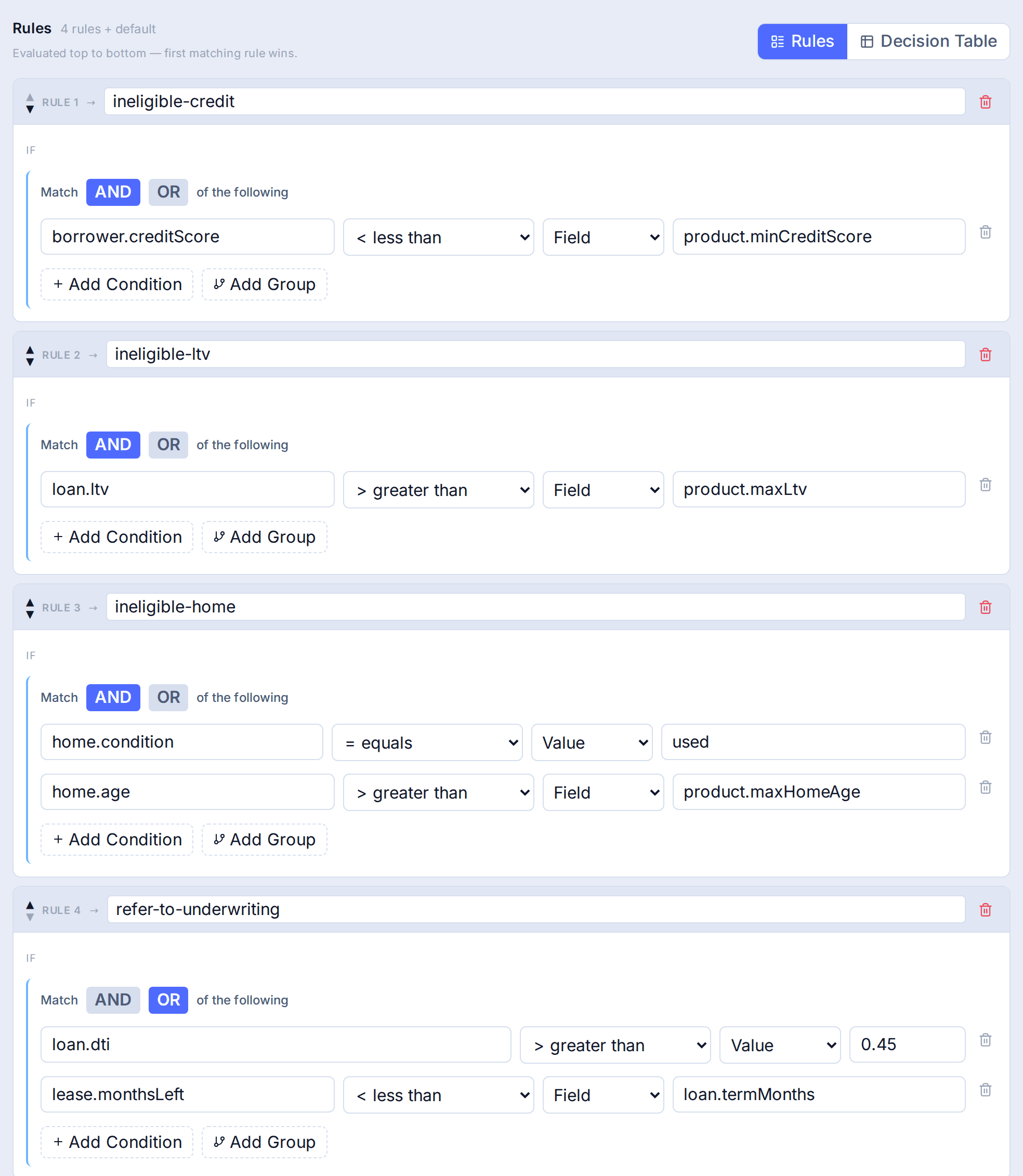
Book a demoThe policy editor, not a picture of one.
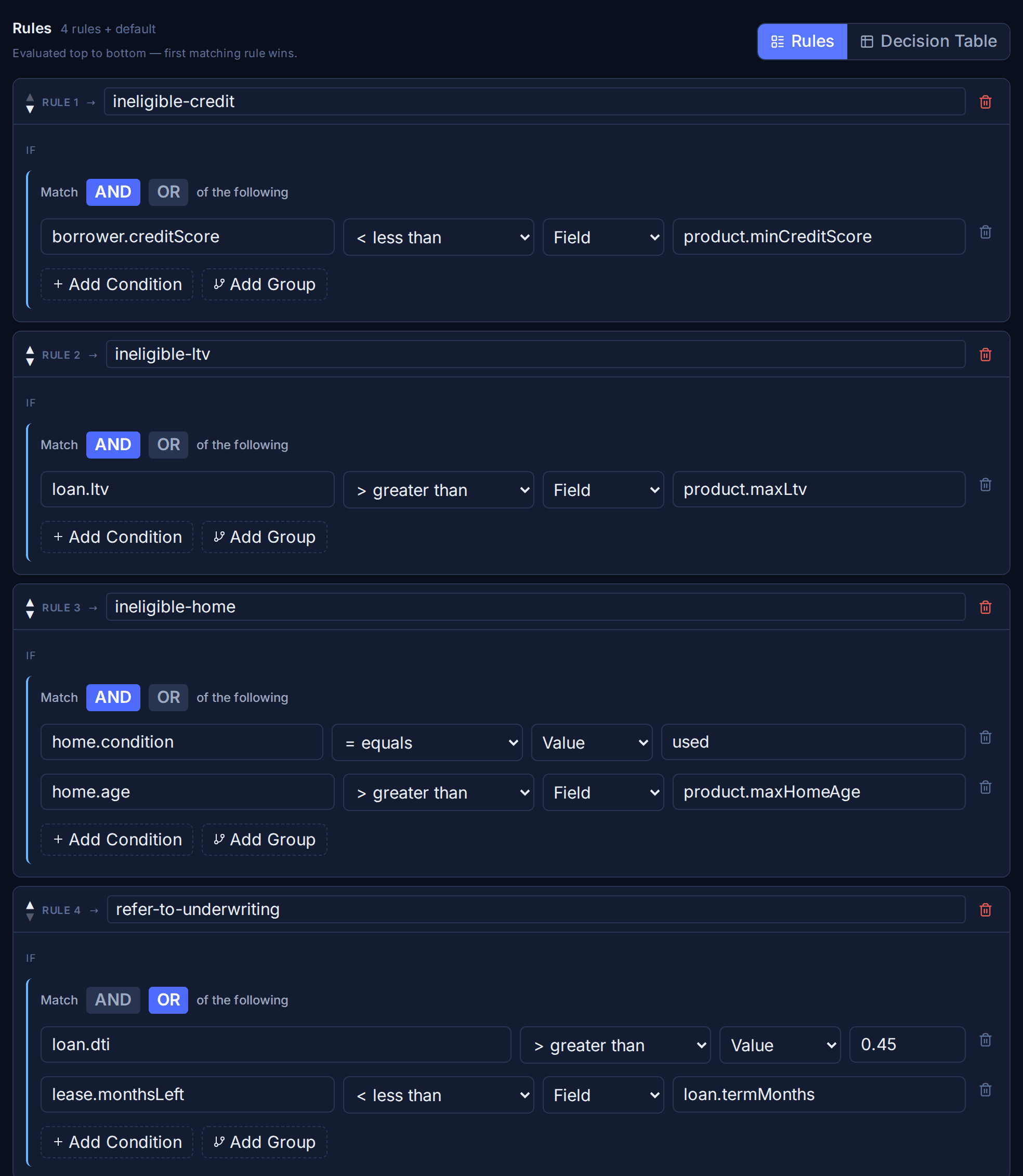
Captured from the running application against a chattel eligibility policy.
Your chattel overlays, as conditions
Four branches and a default. Three limits point at the product — minimum score, maximum LTV, maximum home age for a used home — rather than at numbers typed into the rule, and the lot lease is checked against the loan term. Raising a limit on one product is a table edit, not a deployment.
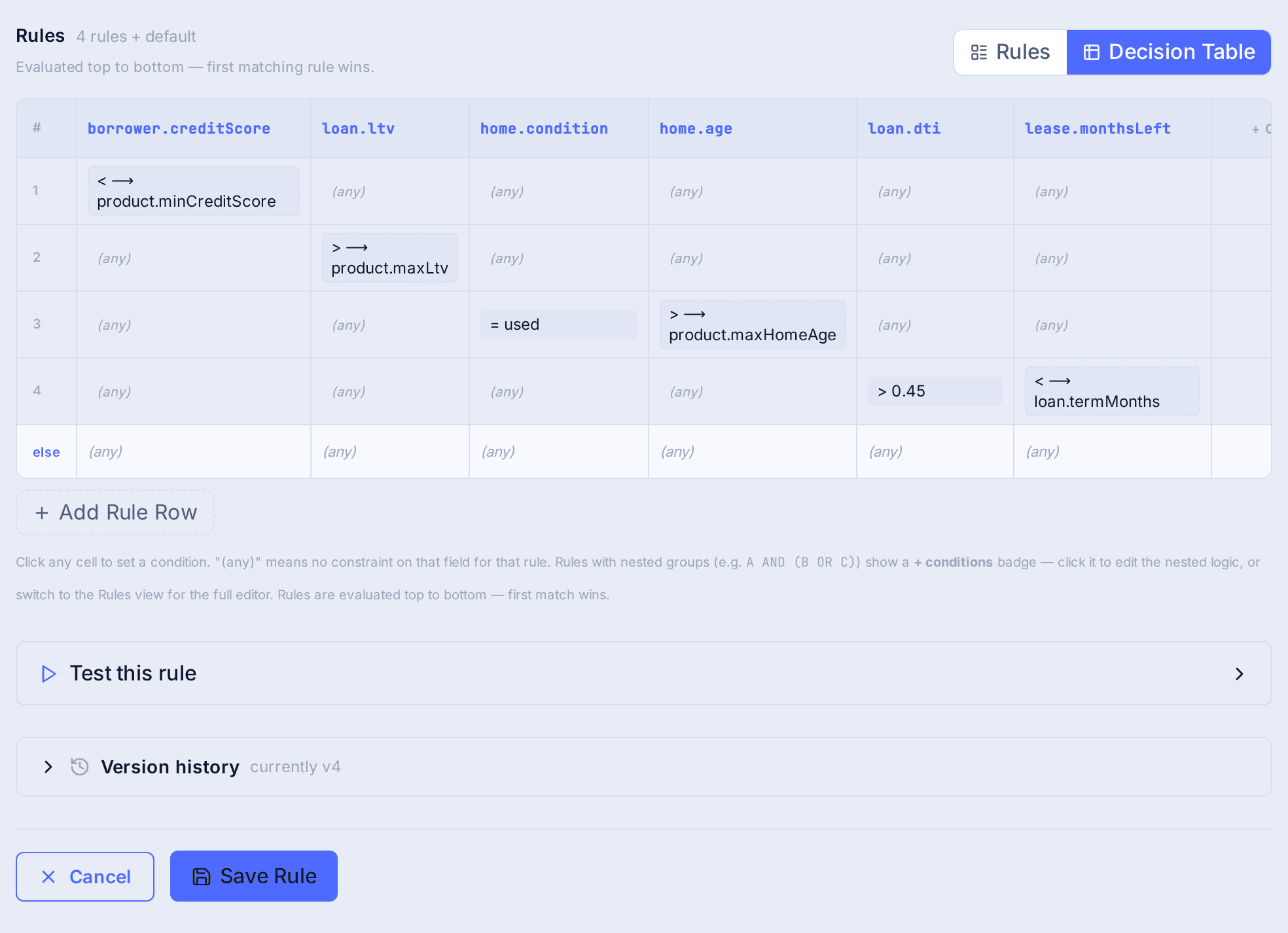
The same overlays, as a grid
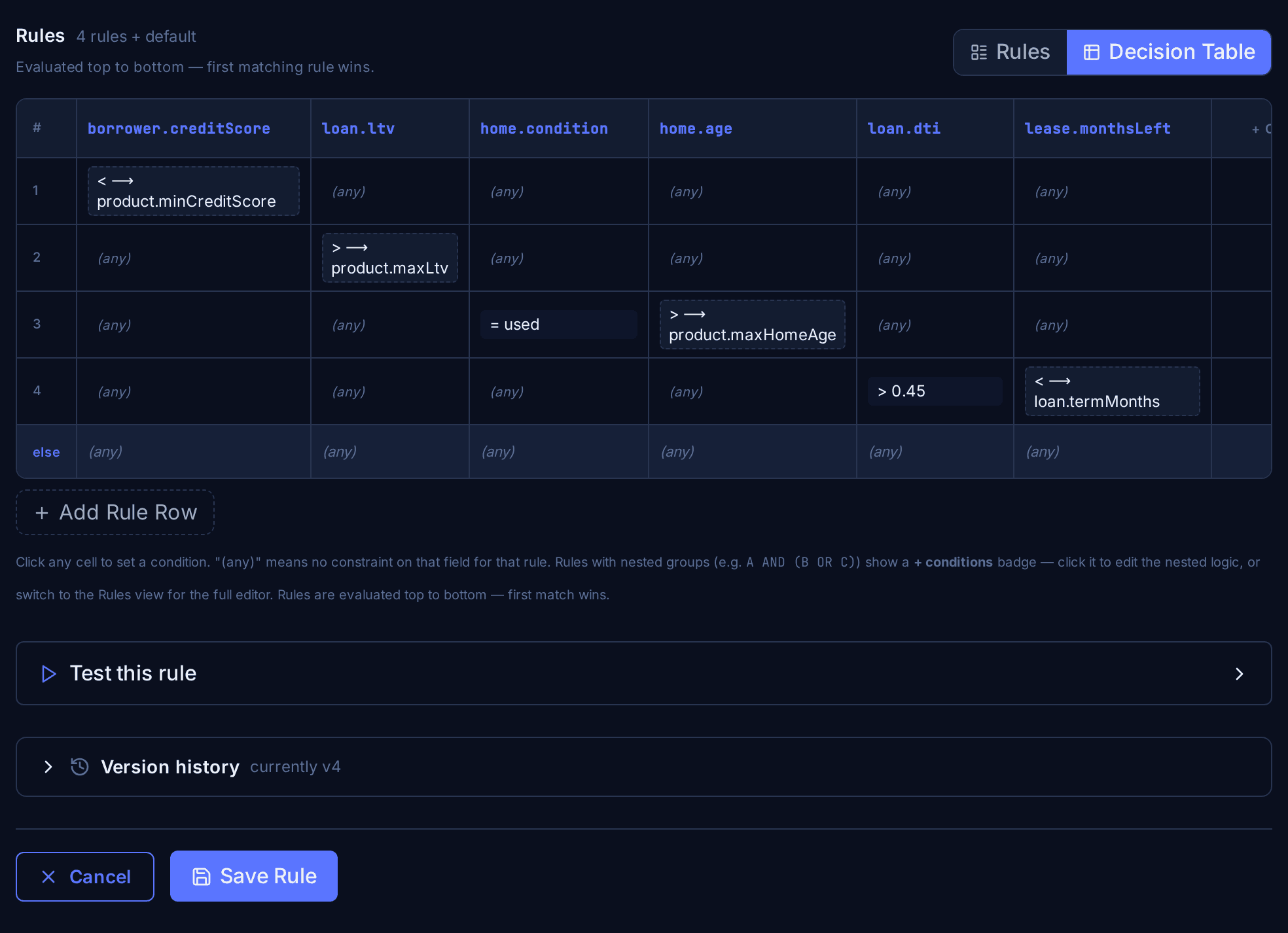
Columns are the facts the policy reads, rows are the outcomes. (any) means that row places no constraint on that field. Underwriters tend to read this one; the condition view is the same policy.
What runs today, and what does not yet.
Everything in the first column can be shown to you on a call. The rest is labelled for what it is.
Available now
Application intake
Native, versioned application forms — URLA-1003 included — or your own schema over an API. A record keeps the shape it was captured under.
Document custody
Upload against a case, with the type read from the file's content rather than its name, storage per environment, and every access on the audit trail. Reading values out of documents is not part of this today.
Verification policy
Versioned and immutable once published, layered from the tenant down to a single field: minimum confidence, agreeing sources, tolerances, and the fields that always need a person. Corrections supersede; nothing is deleted.
Credit pull
Equifax OneView inside the workflow — credit file, employment and income, alternative data — with a sandbox mode for testing and every access logged.
Qualification maths
DTI, LTV, payment and maximum loan with exact decimal arithmetic and built-in finance functions — not a model doing sums.
Rate and LTV grids
Effective-dated lookup tables selected by several columns at once — product, home condition, occupancy — where the most specific row wins.
Eligibility rules
Your overlays as versioned rules or decision tables, with conditions that compare one field against another so limits live in tables.
Approval gates and queues
Threshold routing to underwriting, credit committee or exception approval, resolved by any-one, all or majority, worked from a queue.
Audit trail and decision records
Hash-chained and verifiable on demand, with the rule version that decided recorded by fingerprint.
Hand-off to your stack
A finished file leaves over a connector you configure — your LOS, your warehouse, your endpoint. No LOS-specific integration to wait for.
Conditions at gates
PTD and PTF gates on the loan's lifecycle hold it until each condition is cleared or waived: templates, borrower uploads from a phone, checks, letters and reminders.
Policy simulation
Replay one file or thousands against a proposed version, shadow it beside live traffic, keep scenario sets, and A/B test a share of real traffic with guardrails.
In development with design partners
Decision notices
Approval, denial and counteroffer documentation generated from the decision record itself.
Draft, approve, publish
A review step between writing a policy change and it deciding anything.
Compliance pack
AI usage register, examiner export and officer attestation — see below.
Next
Pre-built manufactured-home package
Chattel and land-home overlays, rate grids and a document checklist that install in one step. Until then, we configure yours with you.
Servicing
Delinquency, payments and payoff, on the same policy engine and the same record.
It installs as a package: the schemas, rules, workflows, queues, approval groups and reference tables, in one action. Packages are versioned, an upgrade adds what is new without touching what you have changed, and what you author in your own tenant stays yours.
Everything in the first column can be shown to you on a call.
See it runningPlans for lenders
Lending is included from Professional: loans, conditions, your overlays as versioned rules, and an audit trail.
Professional
Case management, the lab and verticals
Pricing soon
30-day free trial
Start 30-day trial- 100 active workflows
- 50,000 workflow runs a month
- 50 seats
- 50 installed templates
- Bring your own AI key
- The lending vertical: loans and conditions
- 25 months of run history
Enterprise
Your own sign-on, contract limits and long retention
Custom
Priced for your contract
Contact sales- Limits set to fit your contract
- Bring your own AI key
- The lending vertical: loans and conditions
- Run history kept as long as you need
All paid plans start with a 30-day free trial. No card needed.
- Is there a free plan?
- Yes. Free never ends and has no trial to run out. It is for trying Miji on real work.
- What happens when a trial ends?
- The workspace moves to Free unless you subscribe. Nothing you built is deleted.
- Can I use my own AI key?
- Yes, on every plan. Plans with a Miji AI allowance can also use the platform's models.
Ready for the examiner's question.
Whoever reviews your files — a state examiner, an investor buying a pool, an auditor — the question comes down to the same one: which policy decided this loan, and why? Miji keeps the answer as the work happens.
Kept for every file today
- The exact policy version that decided, recorded by content fingerprint
- The inputs it saw, with their sources — corrections supersede rather than overwrite
- The branch that fired: eligible, ineligible for a named reason, or referred
- Who approved a referral, and when
- A hash-chained trail over all of it, verifiable on demand
And because the engine applies the policy rather than each processor interpreting it, identical files get identical treatment — the consistency a fair-lending review looks for.
If you sell land-home loans to the GSEs
Freddie Mac Bulletin 2025-16 took effect March 3, 2026, and Fannie Mae Lender Letter LL-2026-04 took effect August 6, 2026. Selling to them now means written AI governance, monitoring of AI-influenced outcomes, an accountable senior officer — and the duty covers AI your vendors provide, not only AI you build.
A security certificate does not answer that. A per-loan record of every AI action, approval and decision, with integrity you can prove, does — and Miji produces it as a by-product of running the work.
What the mandates mean for lendersMiji is not affiliated with or endorsed by Fannie Mae or Freddie Mac. General information, not legal or compliance advice.
The compliance pack
In development with design partnersThe reporting layer on top of that record, shaped with our design partners so it matches how their exams actually run.
AI usage register
Every AI action in a loan's lifecycle — what ran, what it touched, whether a person reviewed it.
Examiner export
A hash-verified bundle per loan or exam period, with a chain-verification report.
Governance policy templates
A written AI governance policy, mapped to the controls that satisfy each part.
Officer attestation
A periodic view for the accountable officer: what AI ran, exception and override rates, chain status.
Fair-lending exports
Decision outcomes, reasons fired and overrides, queryable by period, for your fair-lending analysis.
See the record an examiner would get for one of your files.
Book a demoBetween your retailers and your LOS — not instead of either.
Miji is the governed decision layer. Applications come in from the retailer portals and systems you already run; decided, documented files hand off to your LOS. No rip-and-replace.
Intake
Retailer portal · POS · CRM
Wherever applications arrive today
Miji
Governed prequalification
Documents · verification · credit · grids and rules · approvals · tamper-evident record
Origination
Your LOS
Decided, documented files
Vendor-neutral by design: Miji connects to your existing systems with scoped, credentialed access — and because it's model-agnostic, your AI operation isn't hostage to any single model vendor.
Not an MH lender?
Mortgage, timeshare and consumer lenders run on the same engine.
The application, the verification policy, the credit pull, the maths, the grids, the approvals and the record are the same objects whatever the collateral. What changes is the policy on top — and that is yours. Everything on this page applies; only the examples are manufactured-home ones.
Lending decision automation for any lenderWhat lenders are asking us.
The questions that come up on first calls, answered in writing — and only with what Miji runs today.
Which policy governed this loan? Answering the examiner's question
When a decision is questioned a year later, a log excerpt is a weak answer. The strong answer is the exact policy version, the inputs it saw, and a re-run that produces the same result.
Your verification policy needs version numbers
Credit overlays usually live in a memo, a spreadsheet and three processors' heads. Turning them into a versioned policy is what makes identical files get identical treatment.
Only the files that need judgment: exception queues and approval authority
Reviewing every file is not control — it is a queue. Control is deciding in advance which files need a person, which person, and how many of them have to agree.
See a file go from the retailer to a decision.
Thirty minutes. Bring a product guide or a rate sheet if you like: we'll show you a file running on Miji, the grid row and policy version that decided it, and what's left for the examiner. We're taking on a small group of lenders as design partners.
- A prequalification operation configured to your own overlays, rate and LTV grids
- Early access to the compliance pack — and direct influence on what ships first
- A self-hosted option for lenders with data-residency requirements
- Design-partner pricing, locked in
hello@mijios.ai · mijios.ai/lenders